
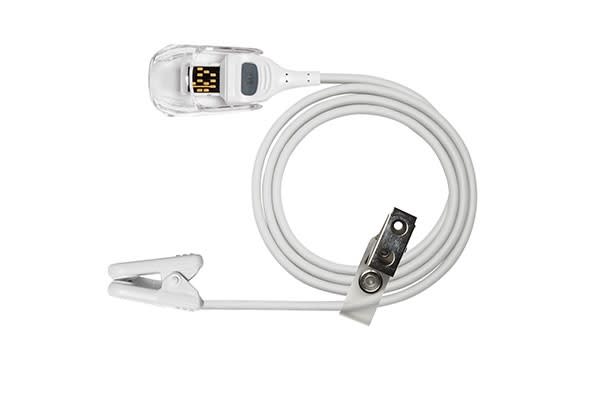
The Masimo Ear Clip sensor provides an alternative site for pulse oximetry. In some cases, access to a patient's hands and feet may not be available, or the hands may not be receiving sufficient blood flow.
For an alternative to the finger-worn sensors typically employed when using a Masimo oximeter, the company also offers an ear clip pulse oximeter sensor. This setup works well for both continuous monitoring and also for stress testing. These sensors are meant to be used on individuals weighing at least 30KG (66 pounds) and is an ideal alternative when the use of a finger sensor is impractical.
The Masimo RD SET Ear Clip Sensor is not meant to be used with any other brand of pulse oximeters other than Masimo. It's designed to be used with the proper Masimo RD SET patient cable. You can see our selection of RD SET patient cables here
To use with RAD-G 9847 - This can be used with the Rad-G Handheld Pulse Oximeter however, it requires the MAS-4773 patient cable
The Masimo RD SET TC-I Reusable Ear Clip Sensor, available from Concord Health Supply, Inc., offers you a critical alternative for monitoring when standard finger sensors are ineffective. This specialized device attaches securely to the ear, allowing you to track the oxygen saturation level in your blood (SpO2) with precision, even in patients with low peripheral perfusion. When you shop at a medical supply store online like Concord, you are looking for healthcare products that solve real-world clinical problems. This sensor is a standout among pulse oximeter accessories because it utilizes Masimo’s RD SET technology to filter out interference. By incorporating this into your health supplies, you gain the flexibility to adapt to various patient conditions, ensuring consistent data acquisition without relying solely on digit-based sensors. Order today.